New Simulation Features and a Server Version for Container Terminals
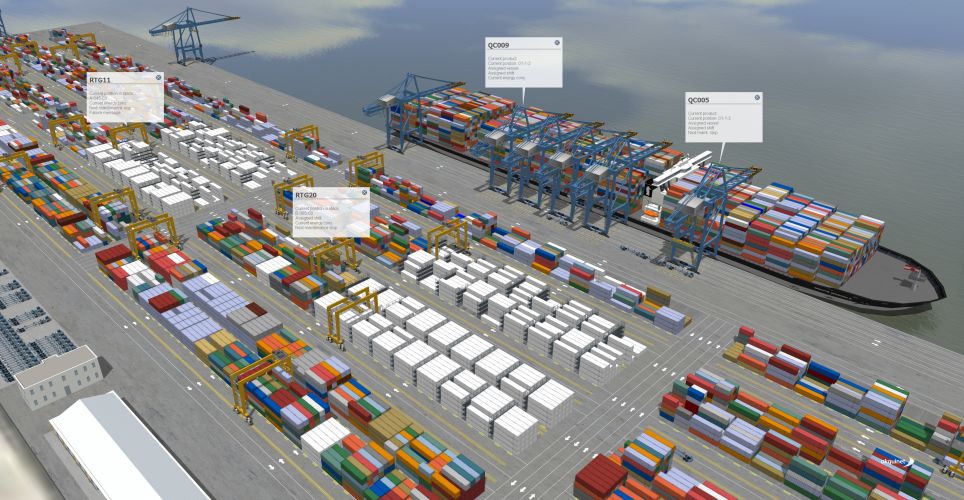
In 2026, the container terminal simulation software CHESSCON received four functional extensions: support for road trains, additional crane movement patterns, pinning and twistlock handling, and realistic spreader movement curves. In parallel, CHESSCON is moving to a server architecture with a web interface, a lightweight client and a REST API. The server version is also the technical basis for combining simulation with AI-based optimization.
Marco Buczilowski, head of CHESSCON development at AKQUINET, presented these changes at the CHESSCON Conference 2026. This article summarizes his talk.
Which new simulation features does CHESSCON offer?
The 2026 extensions aim to make emulation and simulation match real terminal operations as closely as possible.
| Feature | What it does |
|---|---|
|
External trucks
|
Supports road trains and a wider range of truck types. Trucks of any size can arrive at the gate with any container configuration.
|
|
Crane movement patterns
|
Adds more detailed calculation of movement patterns for quay cranes, so different crane behaviours can be compared in the simulation.
|
|
Pinning and twistlock handling
|
Shows twistlock removal in the 3D view. The handling time is configurable. Automated equipment does not enter the area while staff are working. Automated twistlock handling can also be modelled.
|
|
Spreader movement curves
|
Calculates the spreader path based on published research, including braking behaviour. The curve takes all containers on the vessel into account.
|
All of these processes are visualized in the 3D model. This allows terminals to check whether their simulation setup behaves as intended.
What changes with the CHESSCON server version?
The server version changes how users access CHESSCON:
- Web interface: Users log in through a browser and start the CHESSCON applications from there. One access point covers all licensed modules.
- Lightweight client: A small client replaces the full desktop installation. It can be installed without administrator rights. Data is streamed from the server.
- System integration: Support for open standards (REST APIs and MQTT messaging) enables seamless integration of CHESSCON into the terminal's IT infrastructure.
Technically, the CHESSCON server can be deployed with Docker and run in the cloud. It provides a REST API, user management, service and context management for emulation and simulation, and data import from terminal systems. Several terminal layouts can run on one server.
CHESSCON Yard-View is the first application that takes advantage of the new server infrastructure. It displays the entire terminal along with details for every container. Filters allow users to view, for example, all containers scheduled for a vessel during the next shift.
How are simulation and AI-based optimization connected?
The server version links CHESSCON with the optimization platform of the start-up KINT. The process runs in five steps:
- Import: Terminal data is imported from the terminal operating system (TOS), for example Navis.
- Simulate: CHESSCON simulates upcoming shifts. Multiple runs with varied parameters show different ways of operating the same shift.
- Training: The simulation results are used to train the optimization models in KINT.
- Review: The web interface shows the results with a traffic-light system. A red status indicates a problem, for example a vessel that cannot be fully unloaded in time. KINT then proposes changes.
- Re-simulate: The proposed changes are simulated again to check whether the situation improves.
Training does not require a large data set at the start. Historical data can be imported if available. Otherwise, the system learns from each new shift. Where no data exists, expert knowledge and simulation variants can be used.
Why does the simulation have to match real operations?
The AI models do not work with live data. They rely on simulated data. If the simulation deviates from actual terminal operations, the optimization results are not reliable. For this reason, the simulation is calibrated for each terminal individually.
What is planned for 2027?
CHESSCON is being migrated to the server architecture in stages:
- Yard View (available): shows the current state of the terminal’s container yard.
- Live View (planned for early 2027): a digital twin that records every incremental change on the terminal and shows the movement and properties of all equipment in real time, while highlighting bottlenecks and alerts. The current “fat-client” version is move to the new server architecture.
- Simulation and emulation (planned for 2027): rebuilt for the server environment with a new web interface for configuration. Emulators will replicate live operations in the background and provide the same KPIs as the simulation.
Frequently asked questions
What is CHESSCON?
CHESSCON is a software suite by AKQUINET for the simulation, emulation and visualization of container terminal operations.
Does the CHESSCON server version require a local installation?
Only a lightweight client, which can be installed without administrator rights. Data is streamed from the server.
Can CHESSCON run in the cloud?
Yes. The server can be deployed with Docker and run in the cloud or on premises.
Source: This article is based on the talk by Marco Buczilowski (AKQUINET) at the CHESSCON Conference 2026.